OpenClaw vs Forge for Enterprise Deployment
Forge is often described as "OpenClaw for enterprise environments." This page explains the specific architectural and security differences between the two — and where each fits. For Forge's general enterprise positioning across the full competitive landscape (including AgentCore, Foundry, Vertex, and Claude Managed Agents), see the enterprise overview.
Looking for the broader enterprise picture? This page focuses specifically on the OpenClaw comparison. For Forge's full enterprise positioning across managed cloud runtimes, frameworks, and personal-agent tools, see the enterprise overview →
What OpenClaw Proved About AI Agents
OpenClaw demonstrated that AI agents work. With over 68,000 GitHub stars and support for 22+ communication channels, it proved that agents can navigate complex environments, execute multi-step workflows, and automate tasks autonomously. That contribution to the ecosystem is genuine and significant.
OpenClaw is an excellent personal AI agent. It gives individual developers a fast, capable agent optimized for speed, autonomy, and exploration. The framework excels in environments where the user controls the entire runtime — a local machine, a personal cloud instance, a development sandbox.
Why Enterprise Deployments Are Different
When agents move from personal tooling into organizational workloads, the requirements change fundamentally. Enterprise environments need:
- Security boundaries between tenants and teams
- Identity enforcement tied to existing IAM systems
- Structured audit logging for compliance and incident response
- Controlled network egress to prevent data exfiltration
- Deployment portability across cloud providers and on-premise infrastructure
- Reproducible builds that can be verified by security teams
These are not optional features. They are table stakes for any software that touches production data in a regulated organization. Forge focuses on the enterprise deployment constraints that OpenClaw was not designed to address.
Where OpenClaw Architectures Break Down
The challenges are not theoretical. Security researchers have documented specific concerns with deploying personal agent frameworks in enterprise settings:
- Palo Alto Networks assessed OpenClaw as "not designed for enterprise use" with an attack surface they described as "unmanageable and unpredictable."
- Cisco Talos found that 26% of over 31,000 agent skills contained vulnerabilities — from command injection to credential exposure.
- OpenClaw's own maintainers have cautioned that the framework requires significant technical expertise to operate safely, warning that users who "can't understand how to run a command line" face real security risks.
None of these are criticisms of OpenClaw's quality. They are observations about the gap between personal agent frameworks and enterprise deployment requirements.
Inbound Tunnels vs Enterprise Security
The core architectural difference between OpenClaw and Forge comes down to network direction. OpenClaw requires inbound connections — through tunnels, SSH forwarding, or direct port exposure. Forge communicates outbound only.
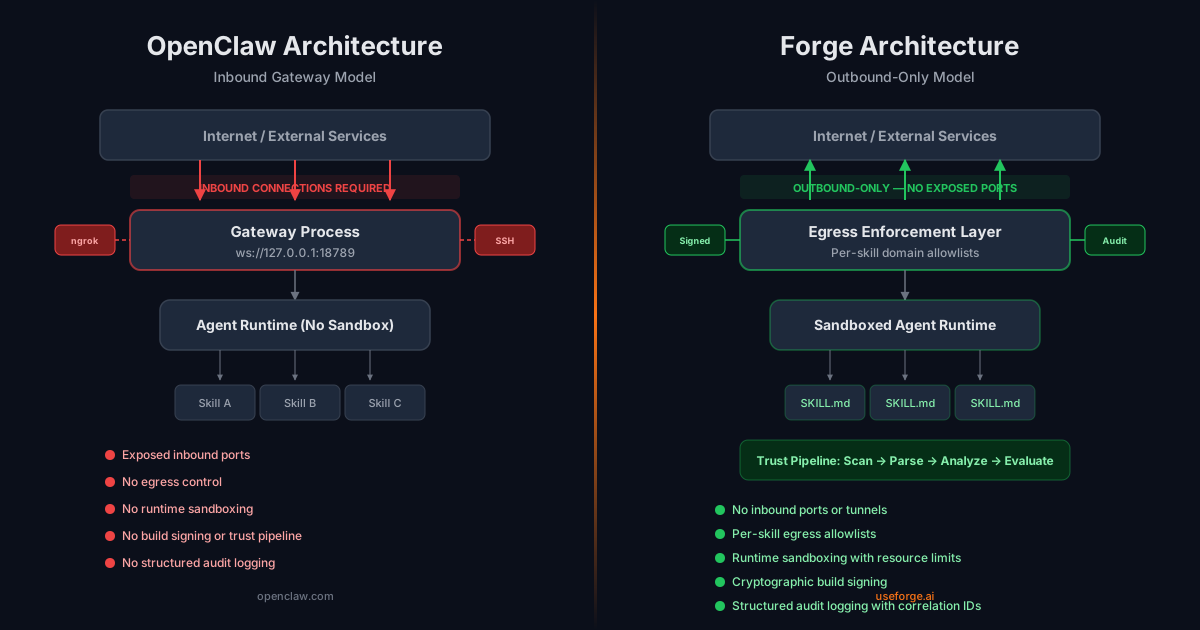
OpenClaw's inbound gateway creates attack surface. Forge's outbound-only model preserves enterprise network boundaries.
The Outbound-Only Runtime Model
Forge's architecture is designed around a single principle: agents should never require inbound network access. Every connection is initiated by the agent, directed outbound to declared endpoints, and governed by per-skill egress allowlists.
Egress Enforcement
Each skill declares the domains it needs. The runtime blocks all other outbound traffic. No blanket internet access.
Runtime Sandboxing
Skills execute in isolated environments with resource limits. One skill cannot access another skill's data or processes.
Build Signing
Agent builds are cryptographically signed. Security teams verify that the deployed agent matches the reviewed and approved version.
Audit Logging
Structured logs with correlation IDs trace every action, API call, and data access across the agent's lifecycle.
OpenClaw vs Forge Architecture Comparison
| Capability | Forge | OpenClaw |
|---|---|---|
| Network model | Outbound-only, no exposed ports | Inbound gateway with tunnels |
| Egress control | Per-skill domain allowlists | No built-in restrictions |
| Runtime isolation | Sandboxed with resource limits | Host environment execution |
| Deployment targets | Local, cloud, VPC, air-gapped | Local, cloud |
| Audit logging | Structured with correlation IDs | Standard application logs |
| Secrets management | Encrypted at rest, scoped per skill | Environment variables |
| Trust model | Automated 4-stage pipeline | User-driven decisions |
| Build signing | Cryptographic verification | Not available |
| Skill format | SKILL.md (portable, language-agnostic) | Framework-specific definitions |
| Channel support | 3 channels (growing) | 22+ channels |
| Best for | Enterprise, regulated, production | Personal, prototyping, exploration |
Frequently Asked Questions
Is Forge an OpenClaw alternative for enterprise?
Forge is often described as "OpenClaw for enterprise environments." While OpenClaw excels as a personal AI agent, Forge was built for the security, compliance, and deployment constraints that enterprise organizations face. See the full comparison for details.
What is the main architectural difference between OpenClaw and Forge?
OpenClaw uses an inbound gateway architecture that requires exposed ports or tunnels. Forge uses outbound-only networking — agents initiate all connections, no ports are exposed, and egress is controlled per-skill. This eliminates the attack surface that enterprise security teams flag in inbound gateway models.
Can I migrate from OpenClaw to Forge?
Forge uses SKILL.md — a portable, language-agnostic skill format — rather than OpenClaw's framework-specific tool definitions. While skills cannot be directly ported, SKILL.md is simpler and enables deployment across local, cloud, VPC, and air-gapped environments. The migration path is about rethinking skill design for enterprise constraints.
Why do enterprise security teams reject OpenClaw deployments?
Enterprise security teams typically reject OpenClaw because the architecture requires inbound network access. This conflicts with zero-trust network policies, creates audit gaps for compliance teams, and expands the attack surface. Forge focuses on the enterprise deployment constraints that OpenClaw was not designed to address — outbound-only networking, runtime sandboxing, and cryptographic build verification.