OpenClaw made one thing clear:
AI agents are no longer hypothetical.
They can:
- Navigate environments
- Plan multi-step actions
- Interact with real systems
- Execute workflows autonomously
That’s a real milestone.
But it exposes a harder question.
What changes when this leap moves from personal assistants to enterprise operations?
Imagine an agent:
- Closing quarterly financial books
- Extracting sensitive ERP data
- Reconciling accounts
- Generating compliance-ready reports
- Routing approvals across departments
Now the stakes are different.
This is no longer a productivity tool.
This is operational infrastructure.
Personal Agents vs Enterprise Agents
OpenClaw demonstrates personal agents extremely well.
Personal agents optimize for:
- Speed
- Autonomy
- Exploration
- Capability
- Convenience
They operate in user-controlled environments.
Enterprise agents operate under different constraints.
Enterprises optimize for:
- Identity enforcement
- Tenant isolation
- Audit logging
- Controlled network egress
- Deployment portability
- Regulatory compliance
Moving from “assistant” to “enterprise worker” fundamentally changes the requirements.
An enterprise agent is not a browser macro.
It behaves like a workload.
The Hidden Infrastructure Problem
Most agent frameworks today are designed for demos.
They often:
- Expose inbound tunnels (ngrok-style)
- Open local ports for callbacks
- Execute arbitrary code without strong isolation
- Blur boundaries between local, staging, and production
- Lack structured identity and tenancy models
That’s acceptable for experimentation.
It’s untenable in a regulated organization.
The next wave of agent failures will not be hallucinations.
They will be:
- Privilege escalation
- Cross-tenant data leakage
- Environment confusion (dev vs prod)
- Unbounded execution
- Uncontrolled outbound calls
When an agent can restart infrastructure, rotate secrets, access databases, and call external APIs, it effectively becomes a privileged service account.
And privileged service accounts require containment.
This is not a prompt problem.
It’s a runtime problem.
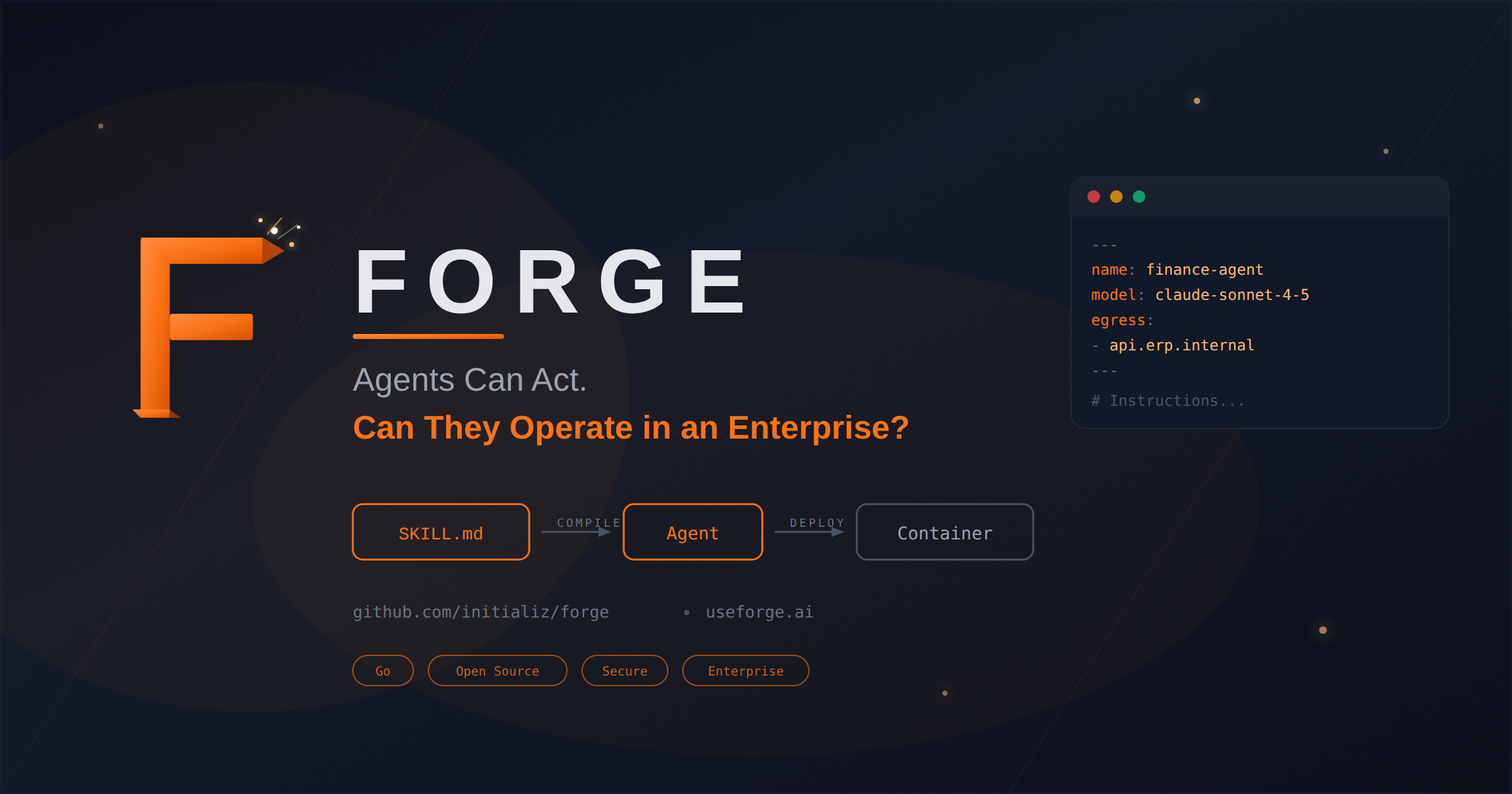
Introducing Forge
Forge is built for this shift.
It is a secure, scalable, enterprise-grade runtime for AI agents.
Not a demo layer.
Not a wrapper.
Infrastructure.
Forge allows you to:
- Run agents locally
- Deploy the same agent to a corporate VPC
- Operate in private cloud environments
- Run inside air-gapped clusters
- Avoid inbound tunnels entirely
- Maintain outbound-only communication models
- Preserve strict environment boundaries
Without rewriting agent code.
The same agent definition runs across environments — predictably.
The Principles Behind Forge
Atomicity
Every execution is isolated and scoped.
Skills define what an agent can do. Execution is bounded. Side effects are controlled.
Agents behave like contained workloads — not autonomous chaos.
Strong execution boundaries reduce blast radius.
Security
Forge is outbound-first.
No exposed ports. No developer machine callbacks. No hidden tunnels.
Enterprise security teams require containment.
Forge enforces it.
Portability
The same agent runs:
- On your laptop
- Inside your corporate VPC
- In private cloud
- In air-gapped enterprise clusters
No re-architecture.
No environment drift.
Portability is not optional. It is foundational.
Governance
Enterprise agents require:
- Skill trust models
- Execution scoping
- Secret management
- Production policy enforcement
Forge aligns agent execution with compliance expectations from day one.
Why This Moment Matters
OpenClaw showed that agents can act.
That’s important.
But as capability grows, the real question shifts from:
“Can it do this?”
to:
“Can it do this safely, predictably, and at organizational scale?”
A single hour of downtime in a large enterprise can cost hundreds of thousands of dollars.
A compliance violation can cost millions.
Unsafe automation at scale becomes a board-level issue.
The agent revolution will not be limited by intelligence.
It will be limited by infrastructure.
Personal AI Is Just the Beginning
Personal AI will continue to accelerate innovation.
But enterprises require more than capability.
They require:
- Boundaries
- Observability
- Identity
- Policy alignment
- Deployment control
- Portability guarantees
Agents must graduate from demos to disciplined workloads.
That transition demands a hardened runtime layer.
The Next Phase of Agents
We believe the future is an enterprise AI workforce.
Agents that:
- Triage incidents
- Manage infrastructure
- Execute business workflows
- Integrate with Slack, Jira, GitHub
- Operate across environments
- Remain auditable and portable
That future cannot rely on ad-hoc execution models.
It requires runtime architecture.
Forge Is Open Source
If you’re building agents for production environments, Forge provides the infrastructure layer to run them securely.
Clone the repository. Run an agent locally. Deploy it into your own environment.
No inbound tunnels. No environment drift. No architectural compromises.
OpenClaw showed what agents can do.
Forge ensures agents can operate when the work actually matters.
The agent revolution will not be won at the prompt layer.
It will be won at the runtime layer.
That’s where Forge lives.